Showing posts with label Art. Show all posts

Monday, December 31, 2007

Art on drugs

ArtOnDrugs Here is a report on an experiment by the US government in the fifties. An artist produced a series of 9 drawings during the course of an LSD trip. The picture to the right is number 6, presumably when his brain chemistry was the most scrambled. Picture number 1 was a rather conventional portrait.

I wonder what would happen with an abstract artist, who starts out drawing stuff like this. Would drugs make him draw realistic landscapes?

Friday, December 28, 2007

Alien glyphs

lchztj-homc-zlhrlkdy

Is this an alien alphabet, and is there a secret decoder ring for it? Maybe it's a syllabary, like Katakana. Maybe it's a series of ideograms, like Chinese characters. How could we tell which? Or, just possibly, it's something so alien that we don't even have a category for it.

drohpctt-vmyk


We are literate, so we are predisposed to believe that anything with this combination of regularity and disorder has to mean something. My fingers want to type "symbol", but to call something a symbol is to assume that it has a particular kind of meaning. Maybe the glyphs are asemic writing, decorative but meaningless. How could we tell?

qvjo-cvklotgzpg

The glyphs were inspired by my non-periodic graph paper. I was designing a favicon, and with the limitation of 16 by 16 pixels, I wasn't able to express the idea of a sudoku, so I went with Plan B.

Text

I realized that my favicon was one of a number of variations. Well, of course, let's generate them all and see what they look like. Let's put them next to each other in different combinations and see what happens.

Thursday, December 27, 2007

Who is the artist?

KandidPost Is Thomas Jourdan the artist? He wrote Kandid, the open-source genetic art program that I used to generate this image. He's never even seen the image. On the other hand, many people have contributed to the math behind fractals, genetic algorithms and evolutionary art. Do they deserve some credit?

Is Kandid, the program, the artist? Or is a program just a tool, much like Leonardo's paintbrush was a tool?

Am I, the user, the artist? All I did was click a few buttons and see what happened.

Am I, the editor, the artist? I generated a few dozen images and picked out the one I liked best. That act of selection seems something like art, the same way I take a hundred pictures with my digital camera and delete 99 of them. However, if we call that art, we have to call what art critics do art as well.

Wednesday, December 26, 2007

Math as art

Here is a math video so good that it's fun to watch even if you aren't interested in the math.

In art, there is the problem of perspective, the realistic representation of three-dimensional objects in two dimensions. In Medieval art, the Bayeaux Tapestry for example, objects are flat and depth is indicated by overlapping. During the Renaissance, artists worked out the rules of perspective by trial and error. In the seventeenth century, the mathematicians formalized the process, beat it to death, and called it projective geometry. And now we have come full circle: a video illustrating one of the basic principles of projective geometry, a video that is itself a work of art.

Tuesday, December 25, 2007

Non-periodic graph paper

NonPeriodicGraphPaper This is a variation of my non-periodic plaids. Maybe more practical, maybe not. You can download a 10-page pdf and print out as much as you want. Every page is different. Of course.

Download non-periodic graph paper

You may be asking, "what is non-periodic graph paper good for?" Good question! I just program this stuff, I don't explain it. I program it because I can, not because I have a use in mind.

However: you can draw boxes for flow charts or organization charts and the boxes will line up horizontally and vertically. They won't be the same size, but they'll line up.

You can use the grid to draw large rectangles and subdivide them. Then you can paint them in primary colors. Very Piet Mondrian. The randomness of the grid will keep the composition from looking too regular.

Every snowflake is different. Why not graph paper?

Monday, December 24, 2007

Sudoku pizza

SudokuPizza

The internet is such a wonderful thing! No matter how obsessed I think I am, with a little googling I can find someone else who already been there and done that.

Here is the sudoku pizza, with nine toppings arranged in a sudoku pattern. The picture above is the stage of construction which most clearly shows the sudoku pattern. The skewers are then removed, the pizza is topped with grated cheese, and is baked to a golden brown.

Sunday, December 23, 2007

Random art generator

doodoo_galore Andrej Bauer at the University of Ljubljana has a random art generator. You can type in a name and his computer will scramble the name into a computer program, which then generates the art. The process is random in the sense that you, the user, have no idea how the name you type affects the picture. All you can do is try different names and see what happens.

It takes a few minutes to generate the art, which gives you time to browser the gallery of pictures that other people created. You can vote the pictures up or down, and the most popular pictures eventually make it to a "best of" gallery.

Regruntled_blogspot I picked the picture above from the visitors' gallery. Someone generated it from "doodoo galore". I generated the picture to the left from "Regruntled blogspot". Go figure.

Saturday, December 22, 2007

How to carve a cat

Seam carving is a new technique for content-aware resizing of images. The idea is to squeeze the images without reducing them. An audio analogy would be speeding up a recording without changing the pitch.

The alternatives to seam carving are cropping and shrinking. Cropping loses information at the edges. Shrinking loses detail everywhere. Seam carving analyses the picture and deletes "unimportant" information.

Of course, I can't just read about something like this, I have to download some software and try it for myself. Here is a feral cat, 400 pixels wide:

400px-Feral_cat Now we progressively carve the picture.

350Cat

300Cat

250cat

200Cat

Now the picture is half size. Ouch! The head and tail are about the same size as in the original, and it looks like the algorithm decided that dark shadows, blurry green leaves and white fur were "unimportant" information. The cat's adorable face is preserved. Which makes a certain amount of sense. To me. Maybe not to the cat.

Wednesday, December 19, 2007

Fractal Flame 1

I played around with fractals way back when, but the state of the art has advanced quite a bit since then. Apophysis 2.0 is software that will generate "fractal flames", something like fractals but way cooler. Flam3 is software that will render the individual frames of an animated fractal flame.

At 30 frames per second, and 5 seconds to render a frame, rendering takes 150 times real-time. A four-minute animation takes about ten hours to render. Then there is the time to generate the video from the stills, mix in the music and titles, and upload the thing to YouTube.

All of this doable. The computer does most of the work, while I do something else, like sleep or eat. Unfortunately, I can't do my usual strategy of "let's make a dozen of these and see which one we like best". Someone needs a faster computer.

Monday, December 17, 2007

Non-periodic plaids

AsynchPost

Here's the latest silliness from the Regruntled Computer Works: non-periodic plaids. These are constructed like normal plaids, except that the thread counts are randomized.

I rather like the patterns. I'd like to have a dress shirt made. And I'd like to watch the seamstress try to match the pattern for the pocket! OK, that's just cruel. No pockets.

Humans tend to see patterns that aren't there. Conversely, if they try to randomize something, they make it "too random". I'm guilty, too. I generated lots of these plaids, and discarded the ones that didn't "look right".

I suspect that's part of the reason I find the sudoku patterns so interesting. The rules of the pattern create something with the colors all mixed up. It's not random at all, in fact it's highly structured, but to the eye it looks random without being too random.

Sunday, December 16, 2007

Sudoku cat

Sudokolor Here is Zack the cat, colored in a sudoku pattern. Well, not colored exactly, but color-shifted. You can still see the texture of the fur within the blocks. A sudoku needs nine numbers or colors or patterns. Doing nothing is one, I had two more from Color Shift, and three more from Horse of a Different Color. That makes six. Here I've added three more transformations to my palette, namely canceling the red, canceling the green and canceling the blue. That makes 9 transformations, numbered 1 through 9 and applied in a pattern based on a solved sudoku.

Here is the original picture, shamelessly ripped off from TTB at Blogospherical Ruminations:

ZackEyePost

Saturday, December 8, 2007

Steampunk laptop

SteamPunk This is a modern HP laptop, taken apart and re-assembled with lots of wood, leather and brass to give it a Victorian look. No price is given, but ForbesLife mentioned $1500 for just a keyboard.

The technology part of this thing will be obsolete in three years. How will it fare as art? Consider a Compaq "portable", circa 1983. 28 pounds, shoulder strap, 9-inch green screen, 4.77 Mhz processor, 128KB Memory, 2 5-1/2-inch floppies, no hard drive. No doubt someone could have replaced all the plastic with leather and wood and made it look like a piece of Victorian luggage. Perhaps someone did. So here we are, 25 years later, and it's a ridiculously obsolete piece of technology dressed up as something a hundred years more obsolete. So what? That's what the steampunk laptop is going to look like 25 years from now.

(Steampunk, by analogy with cyberpunk, is a type of science fiction set in the Victorian era, the age of steam engines. The term has spilled over from literature to art.)

Tuesday, December 4, 2007

A horse of a different color

In my Color Shift experiment, I rotated all three colors: red to blue, green to red, blue to green. It is also possible to hold one color constant while switching the other two. There are two ways to shuffle three colors, and three ways to shuffle two colors, for five ways in all. Alternatively, there are six permutations of three objects; the five just described plus the original colors equal six.

With computers, when I come to a fork in the road like this, my inclination is to try all possibilities and see what happens. It doesn't take much more programming, and CPU time is free.

The picture above is the most interesting of the five. I explain this by noting that the background (grass, shrubs) is mostly green, and the foreground (horse) is mostly red, so holding the green constant and switching the red and blue results in a blue horse on a normal-looking background. The dissonance between the foreground and the background is what makes the picture interesting.

This is all very glib, but of course the computer doesn't know which is the foreground and which is the background. There are plenty of optical illusions to show that this is not always so easy for humans to figure out either. I tried averaging all the pixels and found that the picture as a whole is slightly more red than green. Holding red constant and switching green and blue results in a normal-looking horse against a bluish background... which is not interesting. The other three transformations change both the foreground and the background, which is even less interesting.

Of course, what I am looking for is some kind of metric that will tell me which of the five color transformations will likely result in interesting pictures.

Saturday, December 1, 2007

Color Shift


Yet another experimental video. Here the colors are shifted instead of inverted. Inversions change red to an absence of red and vice versa, like a photographic negative. Here I am shifting the red to blue, the green to red, and the blue to green. In the computer, colors are just numbers, and I can do whatever I want with them, including shifting them around.

What I like about this effect is that blacks, grays and whites are unaffected. They contain equal amounts of red, green and blue, so shifting the colors around doesn't change anything. An inversion, on the other hand, will change black into white and white into black.

Watch the horse. The horse has black pupils and white patches that remain constant as the horse changes from brown to purple to green. The fence post stays gray.

Friday, November 30, 2007

Blue sudoku tiles

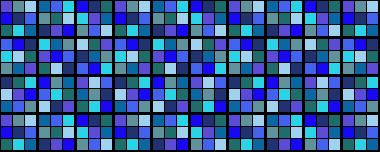
CET suggested the palette for this pattern, based on my rainbow sudoku. The problem is that it is hard to find nine shades of blue that are easy to tell apart.

I think this pattern would be good on the bottom of a swimming pool. It could be manufactured as a puzzle, where the 20 or so clue tiles are glued to a mesh, and the other tiles are loose. The tile layer would have to solve the sudoku as he laid the tile.

I'll do the same for anyone who sends me the hex values for nine colors. See colr.org for some tools.

Tuesday, November 27, 2007

Experimental video


This is a proof-of-concept project that combines still frames into a video. I took a digital photo and modified it programmatically to make 3,888 different frames. I ran the frames through Windows Media Encoder to make a video and edited the video with Windows Movie Maker.

Computer colors are combinations of red, green and blue. A photographic color negative inverts all three colors at the same time. However, if you're messing with the bits and bytes, it's just as easy to invert one color at a time. First I inverted red, then green, then blue, then red again, green again and blue again. At the end, all three colors have been inverted twice. Everything cancels out, and we have the original image again.

Monday, November 26, 2007

Rainbow Sudoku

I took a solved sudoku, replaced the numbers with colors, and generated this image. I added a black background to separate the colors and make it easier to see the 3-by-3 blocks.

Sudokus are tileable. If you take the three blocks from the left of a sudoku and move them around to the right, you still have a sudoku. Similarly, you can move blocks from the top to the bottom. Consequently, if you repeat the pattern, you can pick out any 3-by-3 block and the 8 surrounding blocks, and you have a sudoku.

Unlike the plaids, this pattern is not weavable from horizontal and vertical threads. However, it could be made from little ceramic tiles (and black grout).

Saturday, November 24, 2007

Crawling background

Here is one of those "I wonder if I can do it" projects. I'm reading about background images and I see that the position can be adjusted pixel by pixel. If I can do that, I can make the image move. Already, I'm so focused on the technical details that I'm not even considering whether this is a good idea or not.

Of course, the Blogger platform doesn't co-operate. But I'm also reading about inline frames, which is a way to display a piece of one web page on another. So I put the crawling image on another server, and display it in an inline frame in this post. Maybe I can use the same techniques for something useful.

Saturday, November 17, 2007

The Plaidolyzer


I put the computer to work generating web pages with plaid backgrounds. It looks like you can modify the plaids interactively, but this is an illusion. You are actually navigating through plaids that have been generated ahead of time. Try it and see:
Click here for the Plaidolyzer

I decided to do some variations on the rainbow plaid theme. I shuffled the colors a bit. It turns out that the colors don't look right if they're out of order. For example, if yellow is between orange and green, it looks yellow. If yellow is next to white, it looks white. This puts some constraints on the shuffling.

Next, I tried different backgrounds from white to gray to black. Non-white backgrounds bring out the yellow.


Friday, November 16, 2007

Rainbow brain


Remember the "this is your brain on drugs" ads? Well, this is a genetically modified mouse brain, sliced and lit up under a microscope with fluorescent light.

Borrowing genes from bacteria, coral and jellyfish, Harvard scientists have set mice brains aglow in a bold panoply of colors, revealing the intricate highways and byways of neuronal connections... (more).

Nice colors! I don't know about the science, but it sure works as art. Thanks to TTB for the link.